
From 2005-2020, NAFKAM systematized data from reports provided Scandinavian patients, about their experiences from using complementary and alternative medicine (CAM) and how they perceived that this affected their courses of disease. These reports were collected and managed by NAFKAMs Registry of Exceptional Courses of Disease (RESF).
Introduction
RESF's primary goal was to actively collect information for choosing and designing relevant research projects. Additionally, RESF became a tool for NAFKAM in monitoring the alternative treatment market and to warn the public and health authorities about potential trends threatening patient safety.
An outcome of RESF was knowledge about the difficult treatment choices many patients face when offered CAM. Some contributing cancer patients described this to RESF as standing with "one foot in the grave, and the other one on a bar of soap".
The data from RESF has resulted in one PhD-degree; more than 40 scientific publications; several book projects; many popular-science presentations for patients and lectures for healthcare providers; increased dialogue and an investigation and report ordered by Norwegian health authorities about CAM.
Towards 2020, the number of reports from patients to RESF fell. Also, its methodology for collection and storing of data slowly became outdated. Meanwhile, the general criteria for collecting health data were subject to development, and both patients and providers of health services became more and more involved in different parts of research projects.
After internal discussions at NAFKAM, it was decided that RESF would stop the collection of new data from Jan 1, 2021.
What did we find in the registry?
At the time of digitization and deletion of the registry's records in December 2023, there was a total of 551 records of patients' courses of disease - from 406 women and 145 men. The patients' mean age was 61 years, with an age span from 15 to 99 years at the time of reporting.
The reports came mainly from Norway (n=446), but there were also 91 from Denmark, 9 from Sweden and 3 from the UK (In addition, 2 patients had not stated their country of residence).
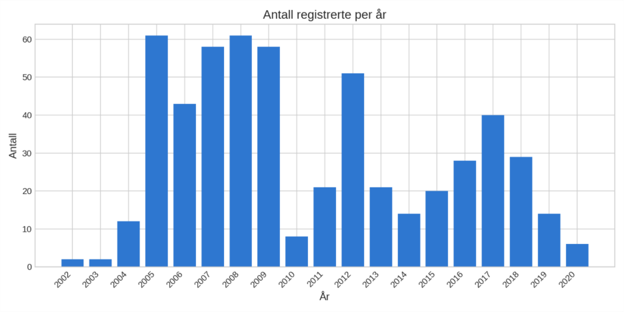
Throughout RESF's active period, the number of reports per year varied greatly, yet there was a clear tendency of decline up to the point in time when the data collection came to a halt in 2021 (See fig. 1):
Fig.1: No. of new reports from patients to NAFKAM, per year:
The dominating groups of diagnoses reported on, were myalgic encephalomyelitis/chronic fatigue syndrome (ME/CFS, 125 reports), multiple sclerosis (MS, 93), cancer (70) and asthma/allergies (32).
The most commonly used therapies were acupuncture, dietary approaches, homeopathy, herbs and supplements, Lightning Process, reflexology/ zone therapy and Reiki healing.
When courses of disease were reported to RESF, the patients' aims and intentions with utilizing CAM often showed themselves to be rather complex; and at times difficult to define unambigously.
The majority of the patients (n=419, 76% of all) stated that they also had used conventional medicine (treatment from the official health care services, provided by licenced healthcare professionals) simultaneously with CAM; while 96 (17%) stated to have used no conventional medicine (For the additional 7%, data about this was lacking).
For an increased understanding of the patients' treatment choices, RESF (with consent from the patient) also collected other types of information; ranging from contact- and identifying information, the patient's own evalution of their course of disease; and information from the patient's journal from healthcare- and CAM providers.
Despite strict routines and great efforts in the gathering of information, RESF did not succeed in having all patients specify the reasons for their use of CAM (see Table 1 about the most important reasons for trying CAM; given by 514 of the total 551):
Table 1: Patients' reported reasons for trying CAM | No. (%) |
Hope for improvement/ cure from chronic conditions | 71 (13,8) |
Desire for a specific CAM therapy/ provider | 58 (11,3) |
Dissatisfaction with official healthcare services, | 44 (8,6) |
Relief/alleviation of symptoms, improvement of quality of life | 36 (7,0) |
Desire for specific diets, herbs or supplements | 25 (4,9) |
Taking control of one's own health, mastering a difficult situation | 24 (4,7) |
Supplementing/ complementing conventional medicine | 8 (1,6) |
Holistic approach | 7 (1,4) |
Availability of treatment, relational aspects etc | 5 (1,0) |
Other reasons/ information not provided | 236 (45,9) |
TOTAL | 514 (100) |
No diagnostic selection was performed at the point of registration a patient's course of disease, and there was no demand for a doctor-confirmed diagnosis. Relatively often, the patients described deep, long-lasting fatigue where their bodies felt heavy and lacking energy; even after rest.
Among the health complaints and -problems reported, challenges with common day-to-day activities and cognitive aspects like memory loss and low concentration were common. Also, many of the patients reporting were cancer survivors, often characterized as "healed from cancer, but without a relevant diagnosis from the healthcare system".
The conditions most often reported to RESF were neurological conditions, ME/ CFS, and cancer. In addition, there was a long line of other conditions such as musculoskeletal disorders, respiratory issues, endocrine/ hormonal disorders, autoimmune diseases and gastrointestinal problems (see Table 2, about the diagnoses/ conditions reporterted to RESF. Of the 551 participants, 191 reported with a diagnosis):
Table 2: Diagnoses – grouped within different diagnoses/ conditions | Antall (%) |
Neurological conditions (e.g MS, migraines, epilepsy, | 123 (24,9) |
CFS/ ME (ME, CFS, chronic fatigue) | 111 (22,5) |
Cancer (cancer, lymphoma, leukemia, | 68 (13,8) |
Musculoskeletal conditions (e.g lumbago, prolapse, fracture, | 40 (8,1) |
Respiratory issues (allergies, asthma, COPD, bronchitis, | 30 6,1) |
Endochrine/ hormonal conditions (diabetes, | 16 (3,2) |
Autoimmune/ connective tissue diseases | 15 (3,0) |
Gastrointestinal problems (IBS, IBD/ ulcerative colitis/ Crohns, | 13 (2,6) |
Cardiovascular disease (Arrhytmia, cardiomyopathy, hypertension, | 6 (1,2) |
Other diagnoses/ information not provided | 71 (14,4) |
TOTAL | 191 (100,0) |
By far, most of the patients reporting to RESF stated having used multiple CAM therapies simultaneously, also while using conventional medicine/ treatment from the official healthcare services. When reporting, the patients were asked to identify what they perceived as the single-most important CAM therapy the had used (See Table 3 below).
In some reports, RESF found it difficult to consider whether what the patient described as CAM, could be classified as CAM or not. E.g, spiritual/ religous activities were reported as CAM, even if such per se do not initially comply with the Norwegian legal definition of CAM.
Table 3: Most important CAM therapies stated by patients | No. (%) | |
Acupuncture and Traditional chinese medicine | 66 (12,0) | |
Psychological/ mental and Mind-body techniques | 65 (11,8) | |
Herbs, natural remedies and supplements | 55 (10,0) | |
Diets and nutritional programs | 44 (8,0) | |
Biological/ medicinal treatment, IV-therapies, detoxification-based | 37 (6,7) | |
Physical/ manual therapies (massage, cupping, chiropractic/ osteopathic/ | 34 (6,2) | |
Reiki healing, spiritual/ religious prayer, energy-based therapies | 25 (4,5) | |
Homeopathy | 17 (3,1) | |
Machine/ biofrequency-based techniques | 14 (2,5) | |
Other/ information not provided | 194 (35,2) | |
TOTAL | 551 (100) | |
Summary
This report constitutes NAFKAMs summary of RESFs most important content on aggregated levels, after the data collection stopped in 2021.
Over a period of 15 years, NAFKAM collected and systematized data on good and bad courses of disease through RESF from Scandinavian patients, which they themselves associated with their use of CAM. RESF was an important asset to NAFKAM as a source of information to NAFKAMs researchers and projects.
495 (89,8%) of the patients reported that the CAM improved their course of disease, while 49 (8,9%) reported that their courses of disease had worsened from the CAM they had used. (For the remaining 0,4% data on this subject was lacking).
A total of 450 patients (81,6%) were diagnosed by a MD/ GP, while 53 (9,6%) reported that they lacked a doctor-set diagnosis for the problems they reported (For the remaining 8,8% data on this subject was lacking).
All the information that was given to RESF from patients is and will continue to be confidential. Upon deletion of RESFs physical files, selected data was digitized, anonymized and stored as aggregated data in line with NAFKAM and UiTs regulations for handling medical research data.
The RESF registry was a valuable source of information to the researchers and projects at NAFKAM.
Arne Johan Norheim, MD, PhD, Professor
Ola Lillenes, Head of communications NAFKAM
Note
The overviews in tables 1-3 on health issues, reasons for treatment choices and types of CAM therapies used, have been compiled using artificial intelligence (AI), and quality-checked by human competence at NAFKAM before publishing. Read more about how NAFKAM uses AI here.
Read more about RESF here